Thursday, April 9, 2009

Soba to Bara

Ami Yoshida and Toshimaru Nakamura both wrote Japanese-only liner notes to be included with their new duo CD, Soba To Bara (buckwheat noodles and a rose). below is our respectful try at translating both sets of these notes into English, upon request of Dan Warburton and some others.

a couple of notes on Ami's text:

1) the punctuation is exactly copied from Ami's text, the commas and slashes and brackets, etc. for those of you with the actual CD, this is the back side of the notes, with the three larger vertical lines of symbols on the left (that's the title).

2) the words in italics are the original Japanese characters, shown in part because of the occasional wordplay. most of this I'm sure is over non-speakers heads' (a group I am solidly in), but one example we can understand is at the start, the three uses of 'aku'. each time it is pronounced the same way, but the Kanji characters used to represent it each time are different, and in the third case, there are actually four characters as opposed to one the first two times, and it has a different meaning each of the three times.


=====================================================


I Am Watching, Staring At With It
- by Ami Yoshida

I am watching, staring at with it.
I have no eye (me). It is not vacant (aku). It is not evil (aku).

I mistake a white world for somewhere [evil/scum/open/vacant] (aku). What, were my eyes? Can I call them, eyes? I [hope/care/mechanize/write] (ki) it. I am confused with that I want to [see/bear/beautify/examine/fascinate] (mi) it. I want to [see/beautify/fascinate] (mi) it toward what is [favorable/good/intoxicating/evening] (yoi) to me. I want, to do it. It is me who wants, it. I am a rose. A rose is me. I am the rose. The rose is me. [Perhaps/people say] (tabun) it is single-stem. I just hope, that it is single-stem. It is a steam that [swings] (yurasu) me. The steam fills the room. But, I swing. I stay, standing. I cling to something, instead of standing on my own. I will stand straight. I need courage (yuuki) to stand up. Nobody, will notice, if, I, stand on my own, or, not, here.

There is a [sound/voice] (ne) off-and-on, of [grinding/scrubbing/frictioning/mushing] (suru). It, moves. There, are, moves. Breathing. Smell. I, am, looking down. I notice, nothing, but, grains, since I am looking down. I am counting, the number, of the grains. Even if I have, eyes, I cannot see it, if I am always looking down. What is, my hope. To, hope. To, decide, what is [favorable/good] (yoi). To, choose. What, is, necessary, to choose. What, who. Choose something. To, gain. Yes, to gain, I choose. Choosing, is me, you, who, what. Choose [what/whom] (mono)?

If it is you, you will, you could, choose, it. I, want, to be, chosen, too. I want to be, chosen. I want it, what, who, you. I do. It is you whom I can [change/buy/return]-[get/capture] (ka-eru). There are grains in front of my eyes. Heavy. What is heavy? Top. Head. My head, cannot, stand, up. I, will, die. I can tell, that I am, breaking down. Death, is, close. My last moment. Death throes. I am not, forgiven. By whom, you, what, I am not, forgiven? To someone except the grains, you, what, I am asking to be forgiven? I [will/want] (shiyo/shitai) to stand straight. Who? Me. I, want. I, think, I will. There is, [someone] (dare). If someone, could, notice me, I will stand on my own here.

I decide. I decide who I am. I rule myself. I hate standing on its own with no decision.

In the dim restaurant. There is only one small window. A hand opens it. An empty colander. It swings. Steam is up. Wet chopsticks. I swing. And, I stand on my own. It is a moment when, I happen to meet you, you happen to meet me, again. I am ready to fall into the white world. I will be found by you. It was a white world, not a narrow black darkness. A white world of, soba. In the soba that was chosen by you, I throw myself in as something different. To change. To change, you, too. Euphoria of red and white. I am a rose. Forever.


Soba to Bara and Man and Man
- by Toshimaru Nakamura

When I walked into the alley just outside of Komae station, the soba restaurant was there. The owner/chef of the restaurant seemed to be about twenty years older than me. I remember his soft smile and polite, slow manner of talking very well. Since the restaurant was open until midnight, I used to go there in the late night hours mostly. There were only six seats at the counter. Even though the soba and udon noodles were all handmade by the owner himself, the prices were quite reasonable, somewhere between standing-up-eating soba places and regular soba restaurants. Anyway, many characteristics of the restaurant were a little unique, including the way they served soba noodles. When they served soba in a hot soup, they did not rinse soba noodles in cold water after simmering. As a result, the soup became a cloudy white and the noodles themselves got slimy and somewhat lost their shape, becoming not so clean and decorative looking. Instead, the soba obtained a special flavor that wrapped customers in its warmth and softness.

There was also another unique thing about the place. When customers were about to finish eating their soba noodles, the owner/chef offered to fill the bowl with some hot water in which he had just boiled soba noodles in, carrying a ladle filled with the hot water. I don't remember well now, but I guess I was quite surprised at his offer when I had hot soba noodles there for the first time. In general, Japanese add some "soba-yu" (the water the soba was boiled in) to the leftover of "tsuyu"(seasoned soy sauce) and drink the mixture, but do not drink the mixture of hot soba soup and "soba-yu". However, it was surprisingly delicious. By adding a hot "soba-yu" into a cooled down leftover of soup, the original rich flavor of the soup stock came back and made me feel like staying at the counter a longer time. When I felt comfortable with being at the counter, the owner/chef started telling me various stories. He told me that he climbs Mount Fuji every year, and that he is a member of a baseball team, his background and how his restaurant has changed over many years... He also taught me how to make soba noodles and soup stock with showing me each ingredient. But it was a small soba restaurant and not a drinking bar, so I always decided to leave the counter when the next customers came in. There were many days when I was able to listen to the owner/chef's stories for a long time since it was not a busy restaurant, but most of the stories were left unfinished. Some stories were completed later by patching several fragments together, and some fragments of episodes stayed as they were.

Or better yet, it would be nice if we had a "soba-yu" restaurant. In the restaurant, soba noodles would be boiled just to make "soba-yu" which would be the main dish, and occasionally soba noodles could be served to customers on request. No, upon further reflection, soba noodles should not be served before the main "soba-yu". After making "soba-yu", soba noodles should definitely be discarded, and only the "soba-yu" should be served. Or, how about a public bath named "Soba-Yu"? The huge bathtub would be filled with "soba-yu". Floating petals of bright red roses on the white “soba-yu” bath, I may invite the owner/chef of the Komae soba restaurant to join the bath. There could be only two of us in the large bathtub. I could see the chef's awkward face beyond the steam at first, but the smile that he showed me when he offered the soba-yu by carrying a ladle at the height of his face would soon return. After all, we would now be soaked in the hot tub of “soba-yu”. I would like to listen to his stories with no time restriction then.

It was more than ten years ago when I used to go to this soba restaurant. It was when I still lived in Kitami town next to Komae city. Since I moved to another place afterward, I stopped going to the restaurant. Around the time, there was a huge construction going on to raise the Odakyu railway and to build a quadruple track in the area. I thought that the restaurant would not exist any more because of eviction, since the place was right behind the station square. I just thought so with no evidence, and I came to believe so as if it is a fact since I assumed so for a very long time. But I did not confirm that with my eyes. I started caring about the restaurant recently, and feel uneasy. In fact, I cannot stop thinking about the place these days. I am going down to check the restaurant by taking a train in the near future.


(translation by Yuko Zama)

Thursday, January 29, 2009

EL007

by Keith Rowe


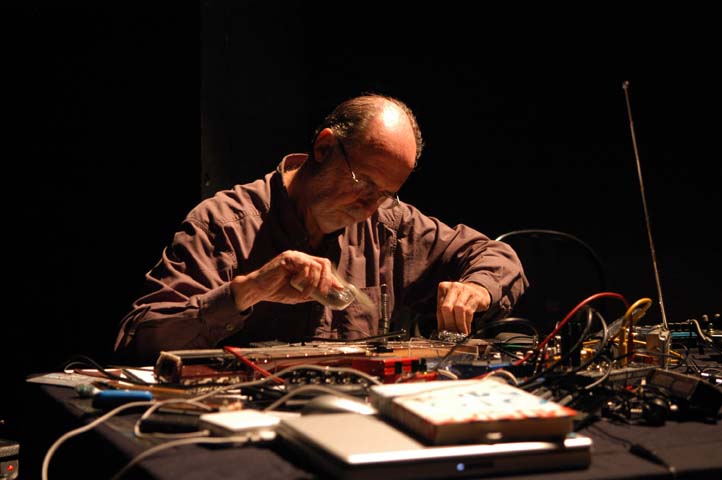
I guess ErstLive 007 starts with an invitation from Jon Abbey and Yuko Zama for me to participate in their AMPLIFY: light festival in Tokyo September 2008, and that I would be the only non-Japanese performer.

The concept for my solo performance was only formed the night previous to the performance itself. Thinking about the forthcoming solo, I felt the need to somehow make clear “who I was”: what my background is, what are my concerns? Something about my interest, the music I love, the sounds that have influenced me, during the performance I came to realise these could be regarded as “Cultural Templates”. Also important was the desire to feel a freedom with regard to the performance’s shape and content, along with the freedom to break rules. For almost half of the solo’s duration, I utilise long sections of pre-recorded classical music unprocessed, unaltered, and presented as it is, I considered this a break from the normal expectations.


The overall form of the performance came from Jackson Pollock’s 1952 painting “Blue Poles” although my performance would only reveal “Four Poles” (the four cultural templates which form the focus of the performance. During the three or four months leading up to the Tokyo festival, I had decided to revisit techniques from the past that I had abandoned. For the festival I had decided to resurrect my obsessive use of clear plastic lids from the mid sixties, along with a bow from the same period, and from the early eighties the steel pan scrubber.

The solo starts with the pan scrubber, clear plastic lid, and contact mike. I wanted to commence with a playing style that could be interpreted as inept or clumsy even, to have the feeling of a deliberate paucity of means as well as openness, that would both refer to earlier periods of my playing (late 1965-middle 1966) but also retain its asceticism.


At 2:14 is the first of the cultural templates, Alessandro Marcello’s Concerto for oboe in D minor (c. 1717). This piece, like all the templates, can be regarded as multi-dimensional or multi-layered. These dimensions/layers in the Marcello refer to:

the artist in society
solo with accompanist
point and line
point and mass
centre line in Treatise
my role as basso continuo in AMM (rearmost wheel in the Yellow Truck 1966 AMM image)
the soloist melancholia sense of loss (which bookends the Purcell lament at the end of the piece)
how the instrument is “touched”, the sensitivity of touch
its binary nature
translating material between forms (difficult to describe, an art school task is to move the colours of a still life painting one notch around the colour wheel, blue becoming violet, red shifts to orange, yellow becomes green, green becomes blue, etc. A similar exercise would be to hear (translate) Django Reinhardt’s guitar as a soprano saxophone.)


Appreciating the oboe here as Sachiko’s contact microphone, meaning … to listen to this oboe recording but somehow translate it into the sound of the contact mike, or steel pan scrubber, and therefore hearing the orchestral part as silence, or amplified silence, or silence made audible. This was an early AMM technique to make silence audible, which explains how I never thought of continuous sound as drones but as degrees of silence made audible. The rejection of excessive ornamentation and ostentatious display again refers to an early AMM decision to reject gesture, to perform as with little or no bodily movement. Towards the end of this template (around 4:06), I accompany the template with very gentle pan scrubber as if to say “when using our abstract sounds, pan scrubbers, knives, contact mics, etc. we should touch and approach those materials with the same consideration, sensitivity, musicality and sense of occasion as if we were this oboe player."

At 5:01 the template ends, the steel scrubber continues and at 5:36 my human fingers touch the string and sound a single note, followed at 5:43 by a physical movement and sound which represents a time line. The time line technique comes from Cardew's Volo Solo, a difficult piece written for John Tilbury. At some point in the piece, John was obliged to produce around one thousand notes in a very short period. Fascinated by this challenge, I set out how to produce a thousand sounds in as short a period as possible. I achieved more or less a thousand sounds in between one and a half to two seconds, using a one metre steel ruler with a thousand millimetre engraved marks, and running a contact microphone attached to a stylus. This technique came for me to signify time, the passage of time, and here the single note at 5:46 is juxtaposed with a timeline of about 250/300 sounds. My intention was to echo the solo/accompaniment relationship found in the earlier template, reinforcing the reference to Wassily Kandinsky’s 'Point and Line to Plane'.


6:25 refers to the sound of drawing, in an attempt to link the act of drawing with musical performance. I’ve attached a contact microphone to a piece of charcoal, and literally draw around the objects on the table in front of me, in a sense confirming how I regard my musical performances as acts of painting. This is also the first appearance and foreshadowing of the death motif, which is created by a handheld battery powered face fan with its propeller fan modified. Its long menacing sound is combined with a rubbing sound from a contact microphone, the rubbing sound represents human society, the physical (and other) contact between people, at times the rubbing is affectionate, and at other times there is friction. Again, it’s the juxtaposing of long and short sounds.

7:51 is a single note, which leads to a recapitulation of the opening section, the steel scrubber and a clear plastic lid. Perhaps I might say more about the clear plastic lid: it’s a reference to Duchamp’s 'With Hidden Noise' but here I’ve reversed the process, revealing the content, which is the steel scrubber.


Reading the sleeve notes of AMMMUSIC (June 1966) Electra EUK-256, “Seeing as for the first time this reddy brown object with all the strings going away to the left, a bow going across on the right hand side and interwoven amongst the strings various little things, on top of that a plastic lid, and you just watch the sound happening”. Seeing the sound happening is something which has been with me for a long time.

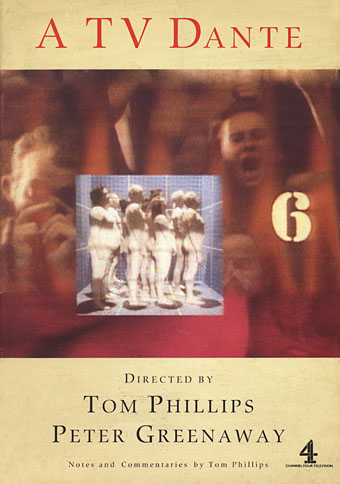
8:29 we enter the world of “affectation”. The detuning here refers to Dante’s Inferno (particularly the Tom Phillips/Peter Greenaway version). The technique here is a live radio broadcast is picked up and transmitted through the earpiece to the guitar pickup, which picks up the broadcast and passes it through to a Boss PS-3, which for me is a way to achieve a form of “affectation” and process. The voices and music of popular culture swirl around, it’s a world without focus, the sound is overprocessed, distorted and overwhelmed by its overprocessing. This is the world I feel we live in.


9:40, hovering above the Inferno is the second template, Jean-Joseph Cassanea de Mondonville, Grand Motets, Dominus Regnait, (c. 1735).

This template for me poses the question, "What is profundity in the digital age?" If I reflect on other music from the early/mid 1700’s, we find the dominance of the viola da gamba is being challenged by the cello, as described in the writings of Hubert Le Blanc (Défense de la basse de viole contre les enterprises du violon et les prétentions du violoncel, 1740.) Le Blanc’s comments recall the later critiques by John Ruskin of James McNeill Whistler in 1878 where Whistler's paintings reflect a fusion between painting music and Japanese culture, and more recently in our own circle's critiques of amplification, electronics, computers and sampling.

Listening to Jean-Baptiste Barrière's 'Sonates pour le violoncelle avec la basse continue' (1733), it seems to me that there are aspects of the violoncello’s sentiment that are not available to the basse de viole. It's not a question of better or worse, good or bad, it's about new sentiments, new relationships. Which leads me to question what are the new sentiments? emotions? Will only the artist and creator of the new recognise its importance? This template is also about how we develop out of the past, how we make the past serve the present.

Clearly the template is about significance and profound meaning from the culture I originate from, my feeling is that this profundity is not universal. In my solo performance here in Tokyo I hold this template high and clear, with a minimum of interference. What I do add to the template are remnants of the inferno below, the dirt and grime of everyday reality, but what should people hearing these templates make of them?

How I listened to the templates during the performance varied. Mostly I imagined in my mind's eye that the significant points suggested by the templates were on transparent sheets. I would conceive that the sheets were laminated on top of each other, perhaps combine all the significances and concepts as one solid mass. Another possibility is to dart around in rapid succession from point to concept to significance to idea in a blizzard of thoughts, or simply remaining on one solitary notion.

12:11 the template ends what follows is a reworking of the plastic lid
12:34 nail/fingers
13:02 single note
13:26 contact mike/serrated edge of knife version of time line through to a steel ruler time line
14:00 steel scrubber
14:25 knife rattle (early technique), again at 14:35, modified at 14:40 onwards.
14:55 return to the infernal, pop radio generally diffused
15:20 knife rattle, again 15:27
15:31 buzzing version of death motif, with knife rattle at 15:44
15:50 single note
15:55 ruler time line


16:31 The third template, Jean-Philippe Rameau, Castor and Pollux, "Tristes apprêts, pâles flambeaux" (1737 and 1754).

This template refers to how revolutions become absorbed. For 50 years after his death, Lully ruled the world of opera in France. This did not change until Rameau presented Hippolyte et Aricie in 1733 to the public, and we now have absorbed that huge revolutionary change and mention Lully and Rameau in the same breath. Sylvie Bouissou writes “In 'Tristes apprêts, pâles flambeaux', Rameau gives a remarkable demonstration of the expressive power of the sub-dominant and the sound-colour of the bassoons that, thanks to him, came into their right as respectable instruments”. So, listening today, that innovation has been absorbed, we hear it as beautiful writing, not as revolutionary.

This template represents the idea that no matter how different, how revolutionary and new we think our creations are, they will become a part of the mainstream, they will become absorbed. Duchamp’s urinal, no matter what observers thought at the time, 100 years later it will be a part of the history of the plastic arts. Picasso’s Les Demoiselles d'Avignon (1907) and Matisse’s Dance (1909) were both regarded as ugly anti-art and without merit at the time, but are now thought of as possibly the most important and greatest paintings of all time.


Therefore this template poses questions:

Will whatever work we present now, at some point lay alongside all the other works that have ever been produced?
Will our abstract scratching rubbings noise metallic scraping electronic interference glitches need to be placed alongside Haydn?

During the template, I gently overlay our present world, sounds drawn from the infernal. There comes a point at 19:55 where our present concerns drive Rameau away, and the death motif which drifted in around 19:17 with radio dominates, but at 20:35 we regain our purpose, and the template is restored.

21:03 steel scrubber/contact mike
21:38 our concerns about death fade
22:22 the template ends

22:41 re-emergence of the underworld, detuned distant voices, with plastic lid bringing us back into focus
23:04 first muffled collision sound from Boss RC-2 loop station
23:12 second RC-2 sound
23:21 third RC-2 sound
23:43 an attempt to revisit a playing style from pre-AMM (Nov ’65), similar to the deliberate style at the beginning
23:46 spring on pickup sound from mid sixties
23:50 repeat spring
23:54 timeline guitar string version
24:00 knife scrub over pickup variation knife/spring/contact mike/lid
24:46 spring, again at 24:51
25:00 entrance of death motif along with spring, here the fan blades are touching the spring which is in contact with the guitar pickup, also there is a contact mike wedged in the spring, all detuned through a PS-3
25:50 all the elements are brought together, spring/fan/scrubber/radio/timelines/rattles, etc.
27:07 of constant importance: layers of activity, low buzz of distancing alienation, immediacy of news reports, sharp focus click and scrapes, the cheap guitar “poppish” wobble at 27:28
28:01 a line is drawn, dissipating the tension, cutting a new section
28:10 revisiting of an old technique (knife rattle), a constant reminder
about the importance of the past
29:07 a violent re-drawing of the earlier line, re-cutting the section
29:30 gradual development of the death motif, this marks the commencement of the final section of the performance

31:01 beneath the death motif starts the final template, Dido’s lament “When I am laid in earth” from Henry Purcell’s Dido and Aeneas (1689).

Fundamentally this template is about why do we make art? Simon Schama's book of essays, 'Hang-Ups', begins as follows:

"Art begins with resistance to loss; or so the ancients supposed. In a chapter on sculpture in his Natural History, Pliny the Elder relates the legend of the Corinthian maid Dibutade who, when faced with the departure of her beloved, sat him down in candlelight and traced his profile from the shadow cast against the wall. Her father, the potter Boutades, pressed clay on the outline to make a portrait relief, thereby inaugurating the genre (and wrecking, one imagines, the delicate shadow-play of his daughter's love-souvenir)." (http://www.guardian.co.uk/artanddesign/2004/nov/06/art)

Is this the origin of art? Constable arresting the temporal clouds, fixing on canvas what is passing? The venerable Bede’s description of life as a bird passing through a banqueting hall, in one window and out of another? This CD fixes aspects of the performance from Tokyo 20th Sept. 2008, in many ways the presence of absence.

During the lament the death motif appears at 31:50, 32:50, 33:05, 33:44, these mark the recalling of our own vulnerabilities.
Dido increasingly screams “Remember Me” “Remember Me” “REMEMBER ME” (6 times).
34:50 a deeper more troubled death motif enters as the template ends.
The significance of the template is the question: is a performance, a painting, a poem, an attempt at immortality?
34:58 the deep throbbing drone is reminiscent of the sound I was exposed to as a child during the blitz of Plymouth 1941, lying in a cage at night, under a table waiting for explosions.
36:19 the end.
As I write these notes (Jan 2009) I am horrified, imagining children in Gaza hearing this sound and then silence.

Thursday, November 20, 2008

AMPLIFY 2008: light

by Yoshiyuki Kitazato


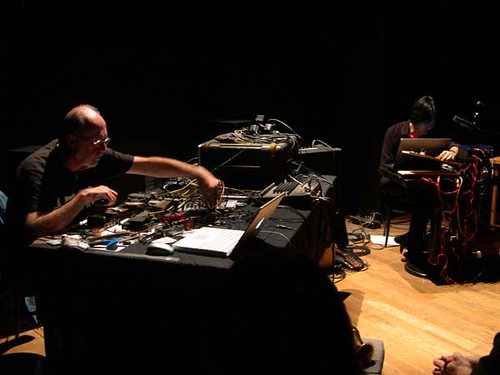
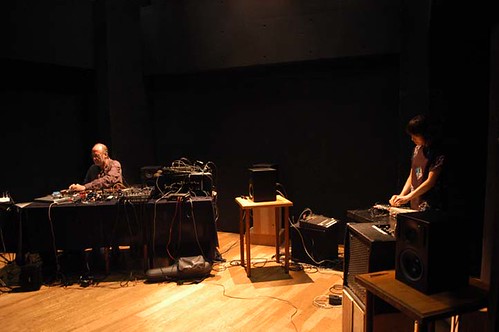
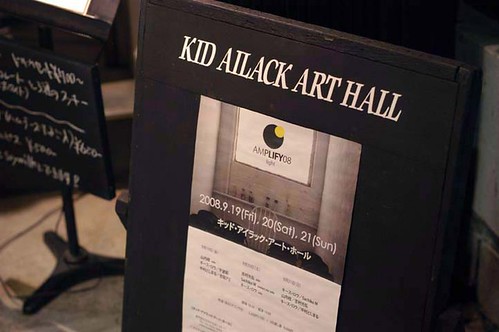
Over three days in which a typhoon struck Tokyo, the U.S. label Erstwhile which Jon Abbey runs with his wife Yuko Zama held a festival: AMPLIFY 2008: light, consisting of solo and duo performances of Japanese musicians and Keith Rowe. Rowe, known as a British avant-garde guitarist who invented a unique method of playing tabletop guitar and bowing guitar strings, was the main performer of the festival. The subtitle of the festival "light", which hints at a light seen in the future music, was Yuko Zama's idea, to dedicate the event to the late music critic and her mentor Toshihiko Shimizu who passed away in May 2007. This event can be noted as a unique experimental music festival, which reflected the label owner's personal vision directly into the selection of the performers, similarly to the recent IMJ's "ftarri" festival which Yoshiyuki Suzuki curated. I think that both of these events should be more appreciated by listeners, considering the fact that the label owners take a risk of bearing all of the expenses personally to realize the festivals.

There were several interesting aspects in the AMPLIFY 2008 festival: to be able to listen to Keith Rowe's 3-day live performance, who had come to Japan only three times previously, with AMM and other projects; as a pure practice of global interaction of improvisers that is meant to be always open beyond national boundaries; to witness what can be seen when the Japanese improv scene, which can be defined as "post-Off Site" movement after Onkyo in Japan, is set in a frame of experimental music from a different perspective. There was also an interesting aspect to interpret the label owner's vision as a criticism against the current improv scene through the festival.

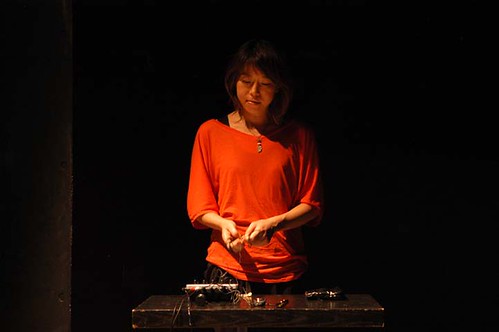
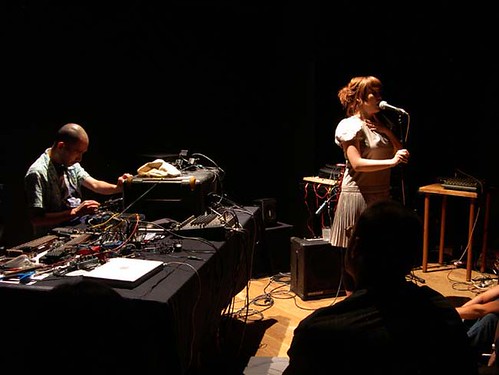
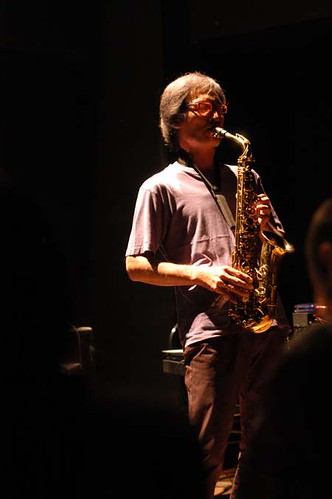
Although Rowe played on all three nights, all of the possible combinations of musicians were not presented in the festival. Taku Unami, Sachiko M and Toshimaru Nakamura were the only musicians that played with Rowe, all in duos. Katsura Yamauchi played solo saxophone (the only traditional instrument seen in the festival) to open the festival, as well as a later duo with Mitsuhiro Yoshimura. The howling voice performer Ami Yoshida played only once, in a duo with Toshimaru Nakamura on the first night. Mitsuhiro Yoshimura, besides the aforementioned duo with his frequent recent collaborator Yamauchi, also did a solo performance, which for me evoked Sachiko M's early experimental sine wave work.

Since the program was formed only with solos and duos as mentioned above, the festival did not have so much possible variation that could be easily expected from this rather big event with 7 performers for 3 days. This simplicity must reflect the curator Jon Abbey's aesthetics. Except Keith Rowe and Toshimaru Nakamura who seemed to play the role of mediators of the whole festival, the other musicians tended to use minimal styles to segment one tone into details. This unique nature of AMPLIFY allowed an open space for the sounds to reach listeners' perception directly, Onkyo sounds dancing in our heads, without taking on a nature of festivity (of a village party, if I dare to say) which is common to most music festivals.


The "Onkyo sound" in this context can be likened to a tightrope act, walking on a wire in the air. A circus high tightrope walker forces the audience to fix their eyes on the single point on the wire where he is stepping, and the tension increasingly rises. In order to make the most of each moment, he dares to risk his life by choosing the uncomfortable, dangerous situation. If a tightrope walker falls off the wire, he cannot try it again. It is a one-shot deal, and the moment of bliss will never come back. Among the musicians who were "walking on a tightrope" of the festival, the most extreme example was perhaps Ami Yoshida's voice.

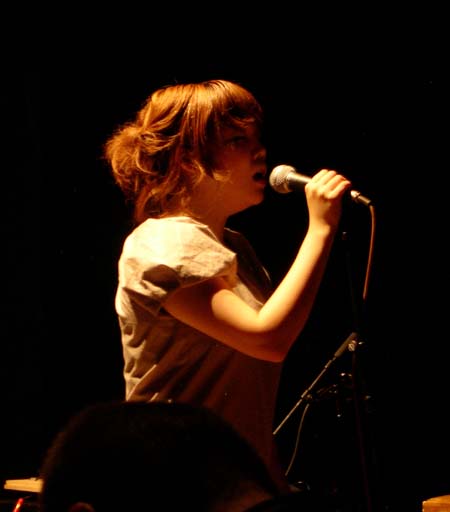
Howling voice requires difficult control to attain fragile tones from a vocal cord that is unstable itself, since vocal cords are affected by the performer's physical condition each day. It is almost beyond human control and perhaps even sometimes more difficult than what the performer themself might expect. Since Yoshida does not use any electronics devices to alter her howling voice, it is even harder to control. Also, listeners naturally tend to hear the howling voice as a human being's "voice" rather than "acoustic sounds", even though the performer insists that they are simply considered to be acoustic sounds. This is perhaps because our brain’s networks are not formed to listen to human voices in that way. In fact, our ears cannot listen to a voice as simple acoustic sounds separate from the person whose voice it is. A voice performer cannot play her voice just like playing an instrument, since the voice more directly represents the performer – in this case Ami Yoshida herself.


The vibration of Ami Yoshida's vocal cords that stems from the deep place where her body and mind connect can also be described as peering into the darkness at the edge of her spiritual cliff. Toshimaru Nakamura's performance wrapped around her performance with a structure of figure and ground appropriately. For Ami Yoshida's voice that has no landing site without any supporting context, Nakamura offered a stable chair on which Yoshida could stay in the air safely. If we use another metaphor from the circus, Nakamura put up safety nets like a spider's nest in the air. Nakamura chose his sounds to let Yoshida’s performance have all the space she needed without disturbing her voice at all. Compared with Ami Yoshida and Gozo Yoshimasu's first duo performance that I saw several months ago, which assumed a crisis-like character, I could see that Yoshida and Nakamura had already established their own methodology despite this being their first duo set ever. Nakamura's skill as a mediator should be more highly regarded.


In a way, the 6th AMPLIFY festival which was held in Tokyo was already structured in advance by the qualities of the seven musicians performing. In general, musicians who played with the limited/alternative method sometimes referred to as ‘reductionism’ were Katsura Yamauchi, Taku Unami, Mitsuhiro Yoshimura and Sachiko M. Keith Rowe and Toshimaru Nakamura also played their instruments to make sounds within this reductionist aesthetic, but that does not mean that they used the same sounds in every set. They changed their sounds in each set to deal with the different environments, which means that they did not restrain their performances to one limited style of improvisation. Rowe and Nakamura did not play like tightrope walkers who walk on a wire. They appeared as performers who conveyed various layers of music behind each separate performance. They had always prepared several ideas for which direction to go or what to choose. This quality of these two musicians must have led them to be mediators of the festival. I understand why the festival was concluded with their duo set.

Perhaps we can draw a borderline here. Some people may criticize some of the paths that Rowe and Nakamura chose as a retreat to the old-style improvisation, which might also mean a defeat of the Onkyo movement against the established nature of free improvisation. However, I do not think that it is creative to be reductionist simply for the sake of reductionism, and ignoring the various circumstances of each occasion. That would be just dogmatism. In the end, the only thing a musician can do is to be true to their own quality that they are destined to deal with for their entire life.


Among the musicians who worked in the reductionist style at AMPLIFY, the ones whose sounds stemmed from their own flesh and blood with no electronics use were Katsura Yamauchi and Ami Yoshida. Apart from the content (see footnote #1 for explanation of this term) of the music, they seemed to try to reach somewhere beyond the modernism of improvisation, and yet this also resulted in appealing to the layers of history of human memories. This happened because they presented voice and instrument on stage in a traditional way.

While there are sounds that are generated from electronics devices with no direct connection to human memories, there are other sounds which dig into the core of the human body and reach the depths of history just like finding a new layer of ore. In the junction of the tabula rasa state of neo-futuristic electronics music and the ancient memories of human beings, we experience a confused sense of time when we hear the sounds. Possibly our modernist method of dealing with time collapses when forced to deal with this kind of approach. In any case, whether the performer's body is actively involved with the performance or not (the fact that it is related to the oral airway like vocal cords or breathing is very important here) is a point, and we can draw another borderline here.


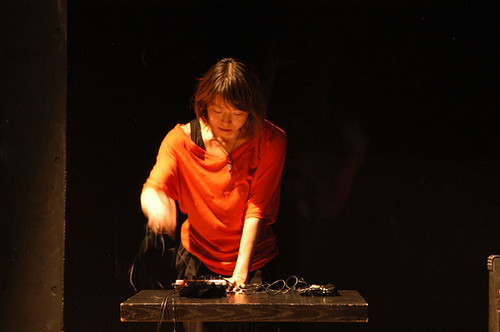
Here, Sachiko M showed up to destabilize the borderline. We may call the performances of Keith Rowe, Taku Unami, Toshimaru Nakamura and Mitsuhiro Yoshimura with an old term live electronics. But Sachiko M's contact mike performance, in which she seemed to play closely with her sense of touch and not just actively involving her fingers with the performance, was different. Just like she picked up sine wave from a sampler, her contact mike performance is based on her intentional misuse of dealing with it like a scrap, not using it as acoustic equipment. She played this recording device, which is supposed to keep silent for the sounds to be recorded, like an amplification device. The contact mike is played to make sounds based on reality, totally free from any memory, while being closely related to her physical being - especially to her sense of touch that can be called cognition of fingers.

Our sense of touch is closely related to our own memories. But it has nothing to do with music in general and is related to different sensations from sounds, such as a pleasurable feeling to touch a lover's skin or a finger to touch a fruit in the kitchen to check how ripe it is. Using contact mikes, Sachiko M established her performance to interact with listeners through a coupling of sense of touch and memories, not by means of a coupling of acoustic sense and memories. She focused the spotlight on the entanglement of subject and object that arises at the birth of sounds, by entwining her fingers on and off the contact mikes, not only with focusing the texture of objective sounds, but also with the cognition of fingers.

On the other hand, the physical senses that sustained Katsura Yamauchi and Ami Yoshida's performances involved the layers of history of human memories, which could sound romantic to some listeners. But the physical sense of Sachiko M is always sliding within a highly aware realm, sticking to complete realism. Her self-definition of "I am not a musician" should be regarded as a key phrase in this context, deeply related to this specific performance.


Just like Derek Bailey used to do, the festival's key musician Keith Rowe seems to fold the layers of several generations of improvised music history into his performances with his background as a long-term musician. He may appear to be a tightrope walker on the surface, but what he played was a live electronics improvisation that could be regarded as a translation act of putting his memories into electronics sounds. It was impressive that he was willing to move towards his co-performers such as Taku Unami, Sachiko M and Toshimaru Nakamura to open a space for dialogues, setting aside his own firm aesthetics that he has built with AMM over many years. It was not like he was donating his time and energy for co-performers from younger generations as a master of free improvisation, but instead, he was genuinely trying to communicate with them with an open mind by paying careful attentions to the environments, always starting fresh with a clean slate in each set. I can tell that this open heart of welcome style of approach made it possible to organize radical improvisation orchestras like MIMEO.

In his solo set, Rowe added some samples of old classical music to realistic electronic sounds that were close to the original style of noise music, occasionally using a portable fan which evoked a propeller noise. The old-world feeling of the sampling and noises that Rowe brought in the performance seemed to be overlapped with his own old memories. In fact, he mentioned that a propeller noise evokes the noise of air raids to him, as he spent his childhood in the midst of wartime. As seen in this fact, Rowe's improvisation is defined with his multilayered experiences and consciousness beyond simply the typical boundaries of 20th century experimental music. This is why his music is performed with infinite disparity every time he plays, even without co-performers and even in this time of the “avant-garde” concept losing its value.


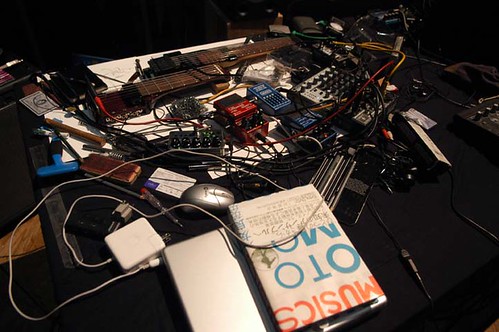
If Ami Yoshida and Katsura Yamauchi are trying to pull something from the old layers of history of human memories that are beyond their own individual consciousness by lowering down their resonant sonde deep into the core of the body - or the central information center of the body. (Of course, it does not mean that they can always reach the old layers of history by exploring their subconscious area every time they play.) On the other hand, Rowe's way of presenting the memories is quite bibliographical. Here is another explanation: Rowe's work table where his guitar rests is just like his study room where his books for reference are piled up high, and his improvisation is performed just like writing a text on brand new paper. However, his performance is not directly descriptive, like expressing his wartime experience with actual sounds of strafing. Instead, he uses indirect sounds such as a propeller noise as an implication, like writing a poem. Perhaps Rowe began the process of performing music on his worktable during the time of AMM. If so, perhaps Rowe is putting elements of his performance on his table one by one, whatever it is Onkyo or reductionism, just like reading a new book. He may not understand some parts instantly, but after reading it repeatedly, he may get it just like filling additional writings between lines.


Needless to say, none of his co-performers, who were walking in a straight, focused line using reductionism-style improvisation, spent their time cultivating their own workspace to collect miscellaneous elements during their sets. Compared with Rowe who was playing like a writer, every co-performer seemed to play much more simply without walking too far from themselves in a text-independent environment. Of course, this was why listeners were able to concentrate on their sounds and be free from the excessive information overflowing in this post-modern time, and could experience the total picture of being, via this self-limited improvisation performance style.

Accordingly, the limited/alternative style of improvisation represented by reductionism seems to be the approach that remains most in actual practice, in spite of various recent attempts to deconstruct the established conventional improvisation performances. For those simple styles of performances, it does not matter if the music is considered a paradigm shift in the history of improvised music or not from a macro viewpoint. Improvisers from the older generations have built their own specific identities by polishing their skills playing free music, to eventually stand on stage as experts of instrumental performance. However, to reach the state of reductionism, they have to abandon their established identities. There were musicians like Derek Bailey who had tried to expose the origin of performance by returning to simple styles of music without abandoning their own expertise.


A reductionism musician tries to make the audience observe the moment when his new identity is constructed each time, instead of reconstructing his identity that was already established at some point in the past. It should remind the audience of the pure methodology of improvisation with which the musician convinces the listeners that the performance is born in this moment, without originating in the past. Perhaps only someone like Keith Rowe – who not only has an open mind of hospitality, but also who can reset himself every time he plays while having a history of being a constructive improviser - is able to show empathy for this new style of Onkyo reductionists. In Rowe's flexible behavior during AMPLIFY 2008, I saw a rare nature that is difficult to find in the U.S. and European improvisation scenes where pushing one’s own identity to the forefront is usually believed to be a virtue. Perhaps Rowe is trying to practice nomadism in the free improv scene, which the late German musician Peter Kowald had been pursuing, too. I understand well why Jon Abbey of Erstwhile values Rowe highly.

Like John Zorn did in the past, Jon Abbey considers the Japanese improv scene to be crucial, and held his label festival in Tokyo for the second time. He considered Keith Rowe as the main performer, included the remarkable mediator Toshimaru Nakamura as an advisor, included avant-garde idols Sachiko M and Ami Yoshida (not every listener may be able to enjoy their performances, but their presence is important to remind of the fact that experimental/improvised music does not belong to only men) to document their current activities, and included Taku Unami, Katsura Yamauchi and Mitsuhiro Yoshimura as new voices in the scene.

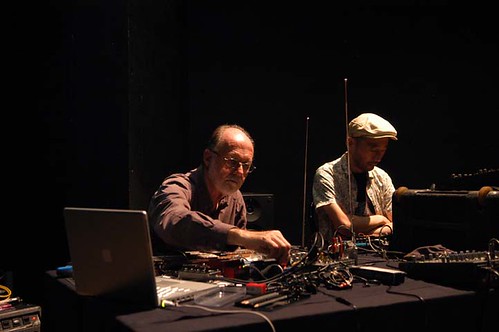
The festival covered a broad range of performances. Katsura Yamauchi presented his European approach using limited/alternative improvisation style by using breathy tones often. Mitsuhiro Yoshimura kept letting out continuous sound like sine wave on and on by using feedback noise of headphone/microphone in a darkened room - it was impossible for the audience to see how he played. Keith Rowe and Taku Unami's duo presented unique installation-style electronics music using a contrast of the speakers' location, with an indistinct combination of their sounds making it hard to distinguish who played which. Ami Yoshida inclined the audience's mind to her howling voice, which created a charged atmosphere in every moment. Sachiko M adhered to her own acoustic realism with an unparalleled contact mike solo performance. Keith Rowe and Sachiko M's duo sounded like solo plus solo rather than a duo performance. There was a duo of Yamauchi and Yoshimura. Then at the end, Rowe and Nakamura presented aggressive duo music like a rock in which Rowe returned to his drone performance.


The curators said that one of the most important purposes of having this festival in Tokyo was to realize the duo of Keith Rowe and Sachiko M. Rowe admires Sachiko M's performance, in which she looks into her self and simply digs deep into the core of her being, as one of the most influential musicians for him. It sounds like the most accurate understanding of Sachiko M's music. In the field of the Onkyo music or limited/alternative improvisation, it seemed that only general theories dominated without considering discrete theories enough for each case so far. That was why Sachiko M and Toshimaru Nakamura have often been mentioned synonymously with Onkyo music. What we need to try is to reconstruct the diversity of music with a fresh approach each time by setting the origin of sound in the 'here and now’ (especially for improvised music) in the field of music criticism, too.

*1: I call it "content" here for convenience, but it might be almost impossible to interpret Ami Yoshida's voice which sounds like a murmur of an unborn baby who is about to become a human being, or Katsura Yamauchi's breath which changes a horn into somewhere like a cave exposed to the wind. These sounds can barely be explained by anomalies of conventional saxophone or voice performances. These sounds seemed to be born without being related to any conventional way. How to describe these sounds is a big issue for us.

(translation by Yuko Zama)
welcome

inspired by a recent thread on IHM ("Critics") and following somewhat in the specific journalistic tradition of IMJ magazine, I decided to start a site which will be run by myself (Jon Abbey), featuring texts related to EAI and the tangential areas (I hope to at least slightly broaden the scope over time). many of these will be musicians writing on other musicians, some of the unheard or underheard (in print form) voices in this music. the pieces will also possibly be in flux after being initially published, so the writers can add, elaborate, delete, whatever, if and when they want, and the idea is to eventually hit enough of a critical mass of quality content so that we have a book.

so, I've been gradually asking people to do specific pieces, and hopefully those will start to come in before too long. in the meantime, respected Tokyo critic Yoshiyuki Kitazato published a lengthy report on the AMPLIFY 2008: light festival this week on a Japanese social networking site and has happily given his permission for Yuko to translate it and for us to use it here to get the ball rolling. hope you enjoy it!

please note that all text on this site is property of the author and the site, and cannot be used elsewhere without permission. also, all photos on this site are by Yuko Zama unless otherwise noted, and also cannot be used elsewhere without her permission.